Electrification of construction equipment: why more and more companies are turning to zero-emission machines
A few years ago, electrification of construction equipment was still a niche topic. Today, it's a factor that's increasingly taken into account when planning construction projects – especially for indoor work, urban zones, or operations sensitive to noise and emissions. We took a closer look at what electrification means in practice and when it's worth it.
Why the topic is becoming more relevant
Three main reasons are driving the growing interest in electric machines:
- Tightening emission limits – especially in Western Europe, more and more cities are introducing low-emission zones with restricted or paid entry for diesel vehicles and equipment; Slovakia already has a legislative framework in place for this, and it's only a matter of time before this trend takes hold here as well.
- Growing ESG requirements – multinational developers and construction companies in particular are increasingly reporting the carbon footprint of their projects, including subcontractors; this trend is gradually making its way to the Slovak market as well.
- Operational advantages – electric drive is quieter, which allows work outside regular hours (hospitals, schools, residential zones) and reduces the strain on operators during long-term work in enclosed spaces.
How it works in practice – same performance, different drive
A common concern with electric machines is the question of power – "won't it be weaker?" Modern electric work platforms and telehandlers are designed today to achieve comparable performance to their diesel versions, just with a different energy source. So the difference isn't in what the machine can do, but in how and where you can deploy it.
For telehandlers, dual power is also increasingly common – the ability to switch between electric and combustion mode depending on whether the machine is working in an enclosed space or outdoors on an open construction site.
Where electric machines are most useful
- Indoor work – halls, underground garages, production spaces where exhaust fumes would be a problem
- Sensitive operations – hospitals, schools, residential zones, historic city centers
- Night or off-hours shifts – low noise levels allow work without disturbing the surroundings
- Companies with international reach – developers and general contractors who already report their carbon footprint according to European ESG standards
What to watch out for when ordering an electric machine
Electrification also brings a few practical questions that need to be resolved in advance:
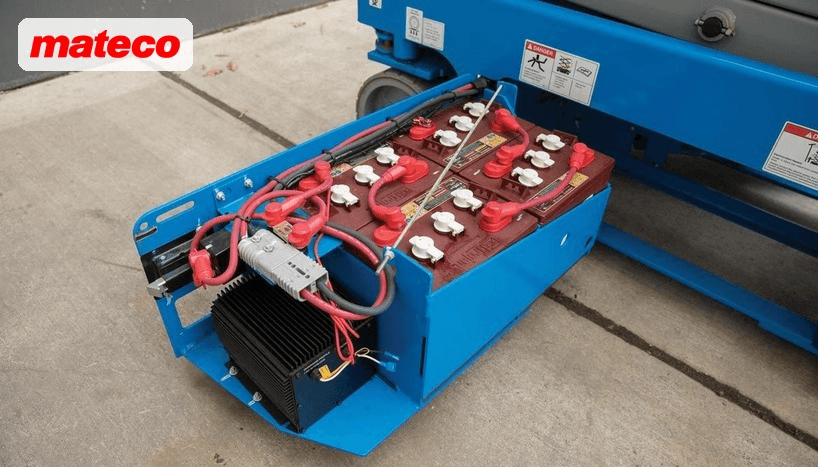
- Battery life per shift – depends on the type of work and intensity of use; it's worth discussing this in advance based on planned deployment.
- Charging infrastructure on site – is a suitable connection available on-site, or does charging need to be handled outside working hours?
- Type of operation – if work alternates between outdoor and indoor, it's worth considering a dual-power machine instead of a purely electric version.
We can go through these three points together right at first contact and recommend a solution tailored exactly to your project.
Thinking about an electric machine for your project? Create a non-binding inquiry and we'll advise you on whether and where electrification would benefit you.
Yours, mateco.